AIRA AI Powered Investor Matching Platform
Designing trust and transparency into an AI-driven SaaS product, helping startup founders cut through investor research noise and manage fundraising pipelines with confidence.
Fundraising is broken for founders
Raising capital is one of the most time-consuming processes a startup founder faces. Identifying relevant investors typically requires hours of manual research across disparate databases, LinkedIn, Crunchbase, and industry networks, with no guarantee that the investors you find actually match your stage, sector, or geography.
AIRA was built to centralise that process: an AI-powered platform that matches founders to investors based on their startup profile, manages outreach workflows, and tracks investor conversations in one place. As the sole designer, I was responsible for the entire product experience, from onboarding through investor discovery, outreach campaigns, contact enrichment, and the investor tracking dashboard.
The core design challenge was one that all AI products face: how do you make users trust recommendations they cannot verify directly?
What existing tools got wrong
I analysed three direct competitors, OpenVC, Foundersuite, and Metal, to understand where existing tools failed founders:
- Fragmented outreach workflow founders were jumping between the platform, their email client, and spreadsheets to manage a single fundraising process.
- Cluttered investor match lists results were hard to interpret, with too much raw data and no clear hierarchy of which investors to prioritise first.
- No next-action guidance after generating investor results, founders did not know what to do next. The workflow ended at discovery, not at outreach.
These three problems shaped AIRA's entire product direction: guided workflow, clear prioritisation, and a path from match to outreach to tracking without leaving the platform.
Three hard problems in AI product design
1. Building trust in AI recommendations
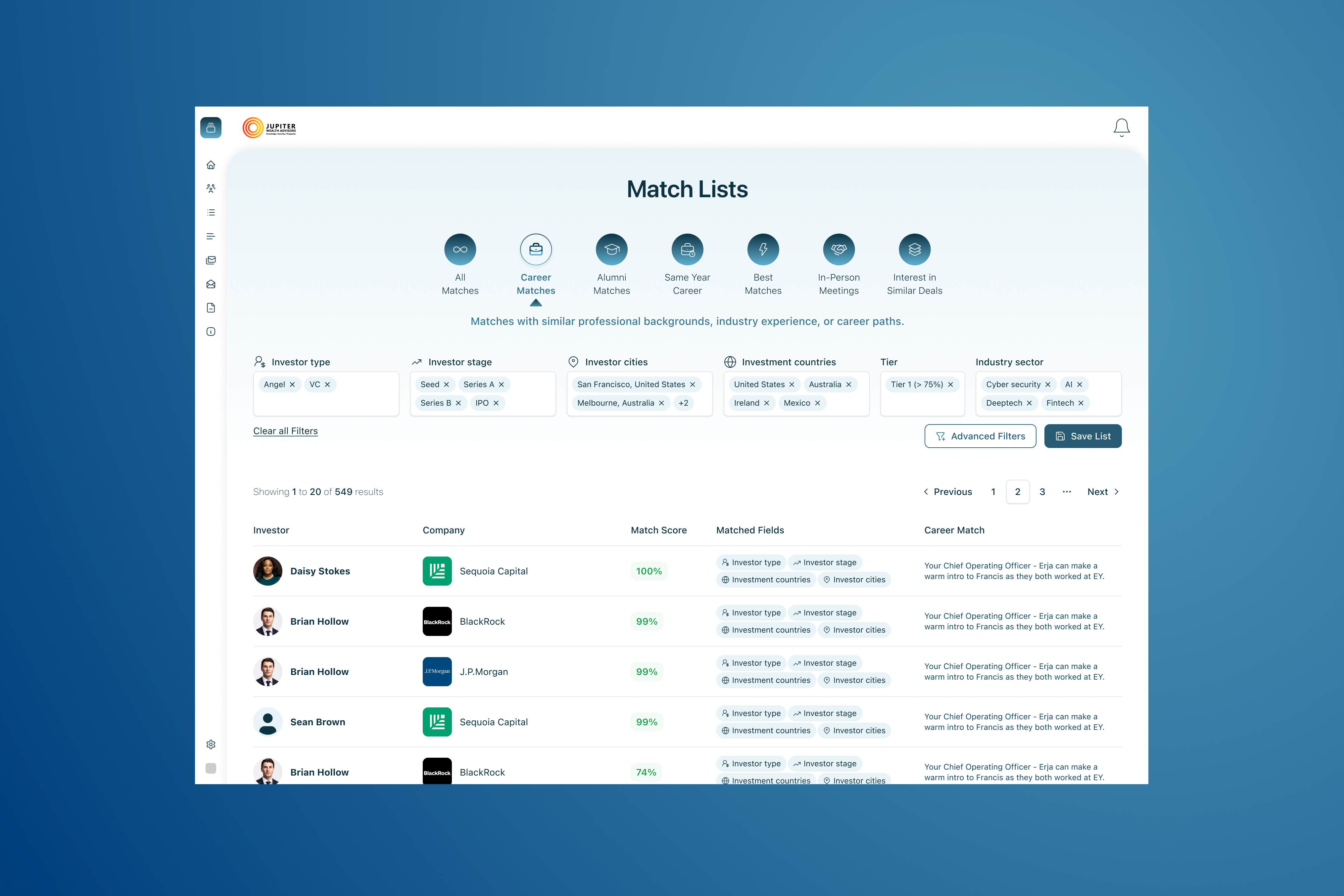
Users needed to understand why a specific investor was matched to their startup, not just that they were. An AI match score with no explanation produces the same anxiety as a random list. The solution was a visible match score with attribute-level breakdowns: this investor matches you on stage, industry, and geography, but not on cheque size. That transparency turned the AI from a black box into a legible decision-making tool.
2. Handling incomplete founder profiles
Match quality depends entirely on the data the founder provides during onboarding. But founders do not always have everything ready, and a long onboarding form creates drop-off before the product delivers any value. The solution was progressive profile completion: a guided onboarding that collected critical matching attributes first, then surfaced prompts to improve match quality as the user engaged with results.
3. Simplifying dense investor data
Investor profiles contain many attributes: stage focus, sector, geography, typical cheque size, past investments, LinkedIn activity. The design challenge was presenting enough data to build confidence without overwhelming the scan experience. The solution was a tiered information hierarchy: key match attributes immediately visible, full profile one click away.
Isolating the outreach campaign workflow
The most significant structural decision I pushed for was collapsing the sidebar navigation and introducing a dedicated 3-step campaign flow for outreach.
The original design kept campaign configuration within the main navigation as a peer feature. In testing, founders would reach the outreach step having already lost context of which investors they had selected, what message they were sending, and what stage they were at. The campaign felt like three separate tasks, not one workflow.
By collapsing the sidebar and presenting a focused 3-step process (select investors, personalise messaging, review email sequences) the outreach workflow became a clear, contained action.
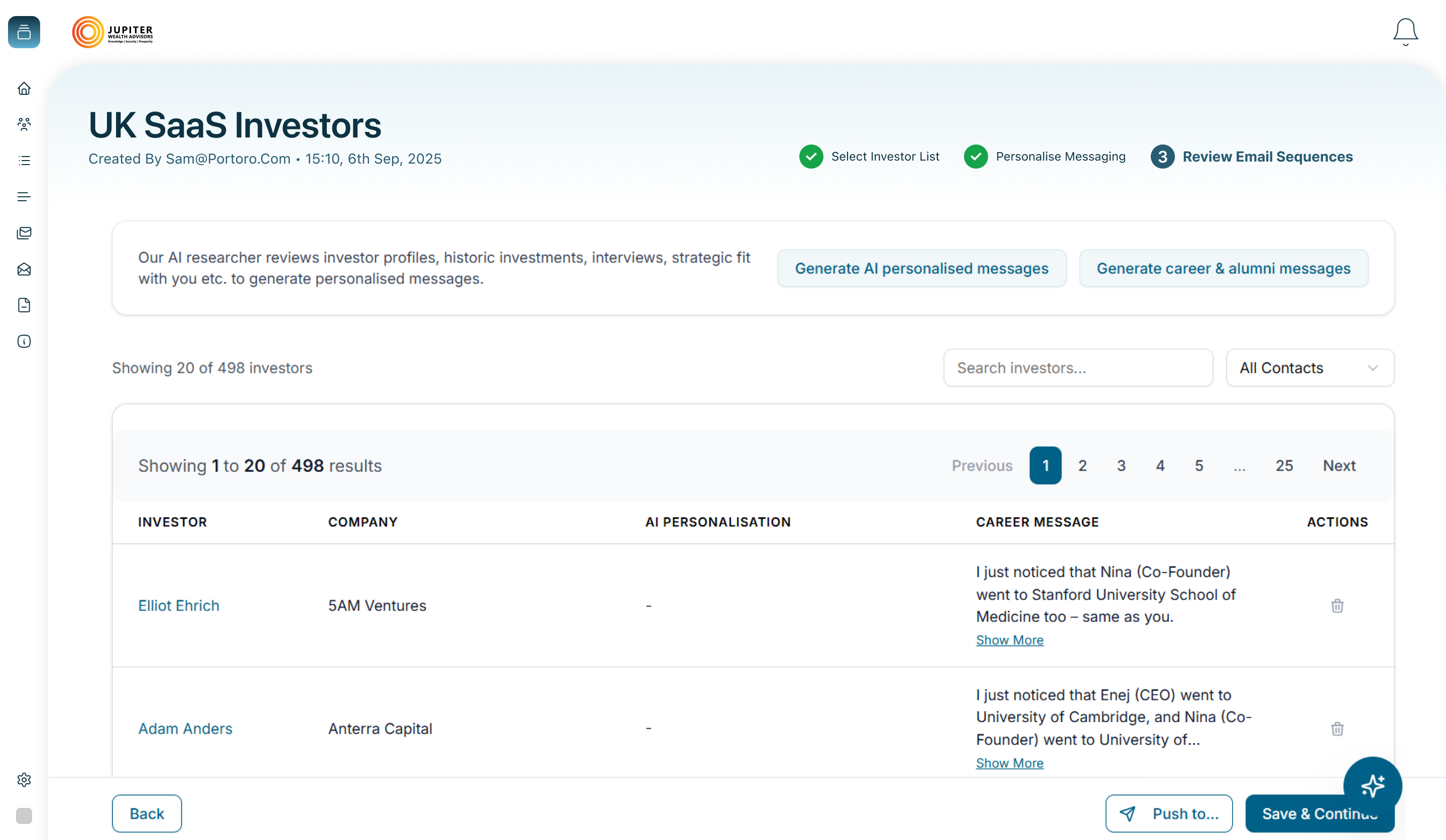
3-step campaign flow with collapsed sidebar: select investors, personalise messaging, review and send
Investor Contact Enrichment
Beyond matching and outreach, the platform needed a way for the company itself to grow and enrich its investor database. Advisory firms using AIRA to raise capital on behalf of multiple startups often had existing contact lists that were incomplete or outdated.
We designed an Investor Contact Enrichment tool that allowed these firms to upload their own contact lists via CSV, run enrichment against the AIRA database, and receive back verified email addresses, LinkedIn profiles, career histories, portfolio companies, investment criteria, and AI-generated insights. This served two purposes simultaneously: it improved outreach quality for the firm and expanded the richness of data in AIRA's own network.
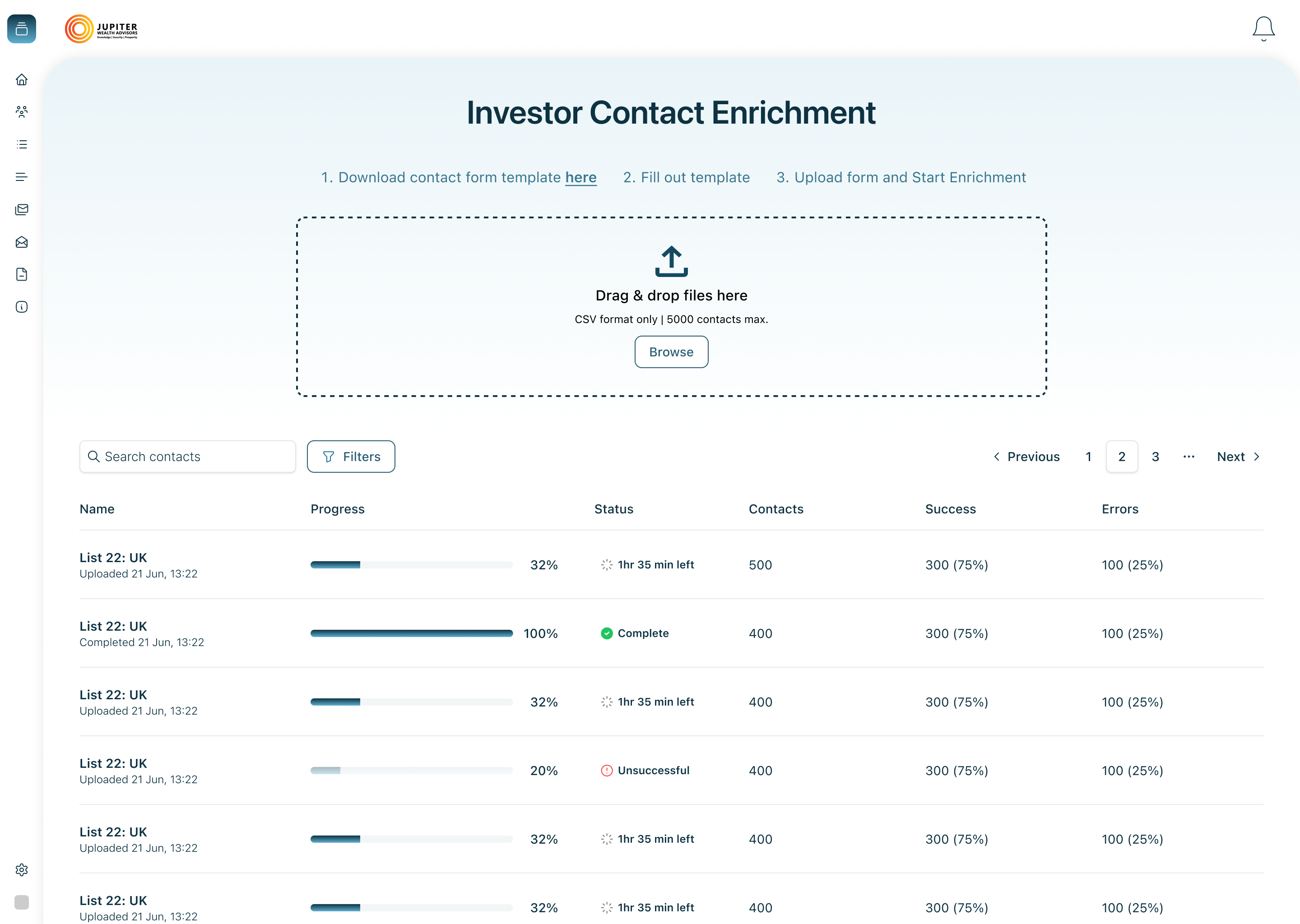
Enrichment dashboard: upload a contact list, track enrichment progress, and monitor success rates across batches
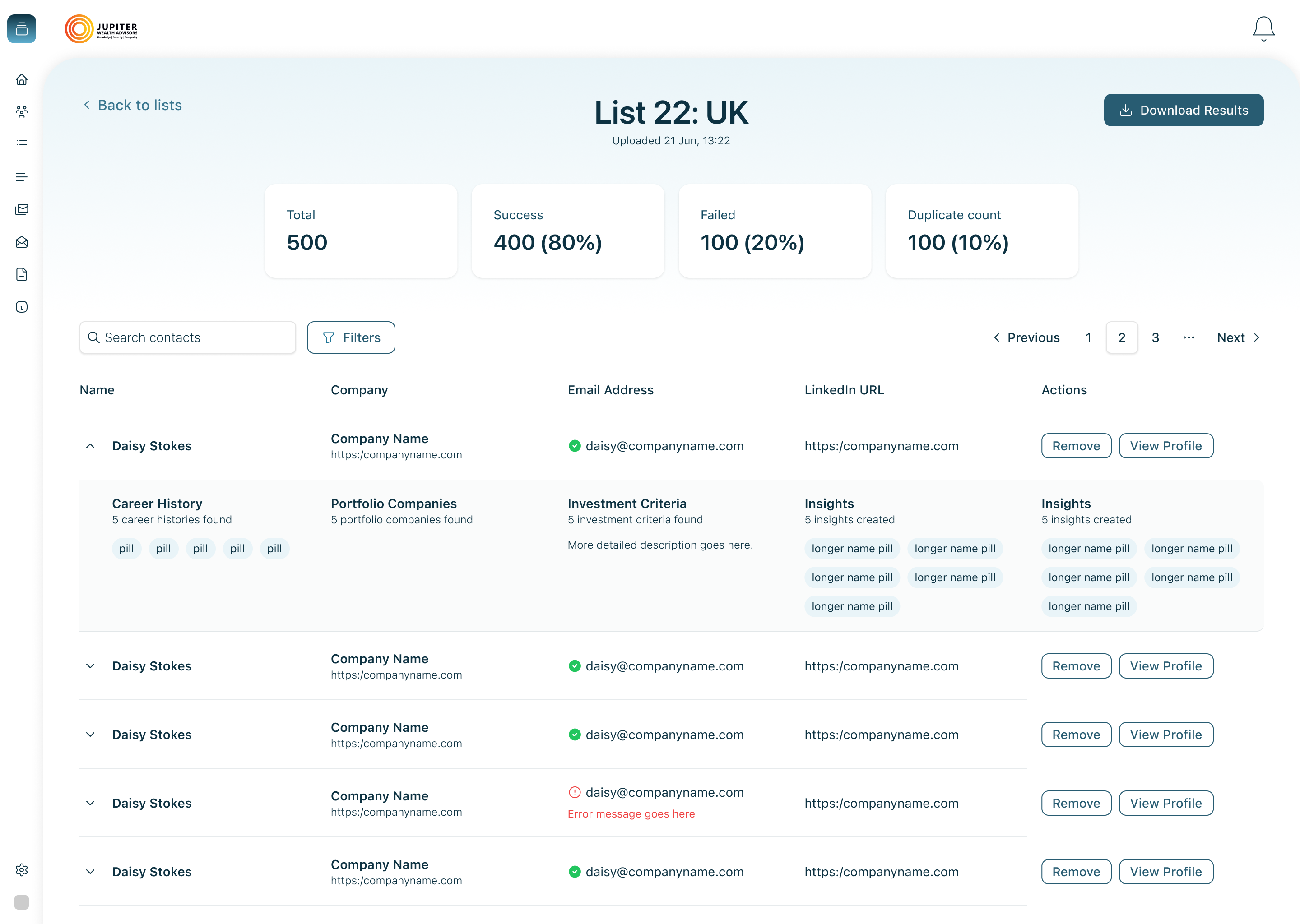
Enrichment results: each contact expanded with verified data, portfolio companies, investment criteria, and AI-generated insights
The key design challenge here was handling partial success gracefully. Enrichment is never 100%. The interface needed to communicate clearly which contacts enriched successfully, which failed, and which were duplicates already in the system, without making a 75% success rate feel like a failure.
Early founders onboarded, positive signal
Early Results
Early founders highlighted ease of use, clear investor matching, and faster investor discovery. The platform moved fundraising research from a multi-tool fragmented process into a single workflow, which was the core promise of the product.
Designing with AI, not just around it
The temptation with AI products is to treat the AI as magic and design around it, letting it do its thing and presenting the output. That produces products that feel impressive for two minutes and useless for twenty. The more important design work was making the AI's reasoning legible: showing why an investor was matched, what the confidence was based on, and where the gaps were. That is what turns AI output into a tool rather than a mystery.
If I were to evolve this further, I would prioritise A/B testing across onboarding flows to understand where profile completion rates drop, and add investor engagement analytics so founders can see which outreach approaches are actually generating responses, closing the loop from sending to learning.